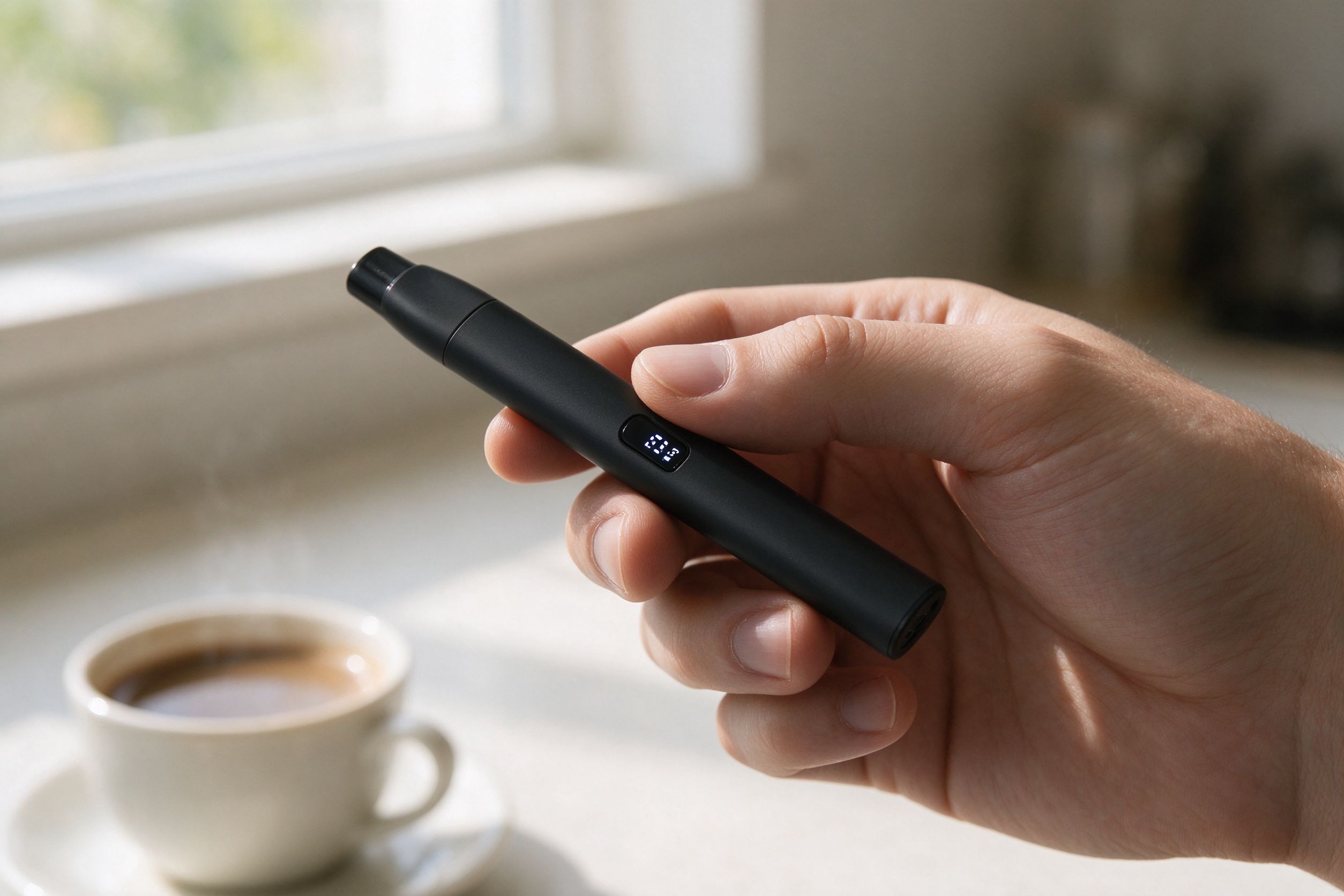
Summary: Why printed puff counts overstate real use, how to convert them into days, and when a disposable stops being good value.
Disposable packaging sells a number, not a device. "5,000 puffs" is the headline on half the shelf, and almost nobody gets 5,000 puffs out of it. Understanding why makes your buying decisions much better.
Where the number comes from
Puff counts are measured on a machine at a fixed draw length — usually about one second — at a fixed interval, until the device stops producing vapour. A human being takes two to three second draws, more frequently, and often harder near the end of the battery. All three raise liquid consumption.
Rule of thumb in the field: real-world puffs land at roughly 60 to 70% of the printed figure. A 5,000 puff device is realistically 3,000 to 3,500 puffs.
Converting puffs into days
Count your own habit first. A pack-a-day smoker typically takes 200 to 300 puffs a day when vaping.
- 200 puffs a day: a realistic 3,000 puff device lasts about 15 days.
- 300 puffs a day: about 10 days.
- 500 puffs a day: about 6 days, which is when people start complaining that disposables "die too fast".
This is also why two people can review the same device and report completely different lifespans. Neither is lying.
Cost per puff is the real comparison
Take the price divided by realistic puffs, not printed puffs:
- $14 device, 5,000 printed, 3,200 real: about 0.44 cents per puff.
- $18 device, 8,000 printed, 5,200 real: about 0.35 cents per puff.
- Refillable pod with a $20 bottle and $10 two-pack of pods: about 0.18 cents per puff.
The bigger disposable is better value than the smaller one at the same brand, but both still cost roughly double a refillable setup. You are paying for the absence of maintenance, and that is a legitimate thing to pay for.
Signs the device is running out before it dies
- Vapour thins out while the battery still fires — the reservoir is nearly empty.
- Flavour turns flat or slightly burnt — the coil is dry.
- Draw gets harder — airflow is clogging with condensate.
- Autofire or no fire at all — the sensor has flooded. Time to stop using it, not to keep puffing.
A disposable that starts tasting burnt should be replaced, not nursed. Dry hits are the worst part of the experience and they are not a nicotine problem.
When to stop buying disposables
If you are on your third disposable in two weeks, the maths has already flipped. A $30 pod kit plus a $20 bottle costs less than three disposables and lasts longer. The signal is not the price of one device, it is how often you are back at the counter.
If you are a light or occasional vaper — under 100 puffs a day — disposables remain the sensible choice, because a refillable sits idle and its liquid ages.
Reading the spec instead of the headline
Puff count is the least reliable number on the listing. The reliable ones are liquid volume in mL, nicotine strength in mg/mL, and battery capacity in mAh. Two devices with 12 mL reservoirs hold the same amount of liquid regardless of what the box promises.
SmokVera lists liquid volume, strength and battery capacity on each disposable, so you can convert to cost per puff before you commit.
Compare disposable specs at SmokVera
Bottom line
Printed puff counts are machine numbers. Divide by the real-world factor of roughly 0.65 to get your own, then divide the price by that. It is the only way to compare a $14 stick with an $18 stick honestly.
For the full cost picture, see Disposable vs Refillable Pod.
For adults 21+. Nicotine is an addictive chemical. Vaping is not an FDA-approved smoking cessation product.